
Before modern gaming brought us ultra-realistic surgery simulators and hospital tycoon franchises, the 1990s laid the groundwork for medical simulation on PC.
The Golden Age of Digital Medicine: Top 10 Medical Sim Games of the 1990s
From pixelated operations to complex hospital management, this era saw developers pushing the limits of what games could teach us about biology, healthcare, and the human body—often with a surprising blend of education, challenge, and humor. Whether you were carefully diagnosing a brain tumor or inflating a comically oversized head, these titles captivated players and inspired future medics, managers, and modders alike. This list dives deep into the 10 most popular and influential medical-themed PC games from 1990 to 1999, celebrating the strange, smart, and sometimes life-saving world of retro med sims.
10. Bodyworks Voyager (1994)
Developer: Mythos Software
An edutainment title where players explore the human body using a miniaturized ship (a la Fantastic Voyage) while zapping viruses and learning anatomy. It mixed action with educational content.
It was a finalist for several edutainment awards in the mid-’90s.
This game left a strong impression on players who grew up in the ‘90s, combining exploration with biology. Fans enjoyed “piloting” through the human body and learning anatomy without it feeling like homework. It made science feel like an adventure. “It was like science class meets Star Fox.”
“Entering the bloodstream!”
9. SimLife (1992)
Developer: Maxis
Focused on genetics and life systems, this game allowed players to manipulate biological ecosystems. While not directly about human medicine, it influenced how players thought about biology and DNA — foundational to medical understanding.
Used in some high school biology curricula in the early ’90s.
While not a pure medical sim, fans appreciated how SimLife made biology interactive. It helped many young players understand genetics in a hands-on way. Some even say it sparked their interest in biology or evolutionary science.
“You have created a species with no reproductive organs.”
8 Cyberia (1994)
Developer: Xatrix Entertainment
This action game integrates bio-tech and cybernetic surgery into its themes. While not a true sim, it features brain-machine interface surgeries and medical science as central plot elements. Its narrative foresaw biotech’s darker applications.
Some medical futurists cited the game as inspiration for early cybernetic ethical debates.
Though more of an action game, fans appreciated the futuristic medical themes and invasive biotech concepts. It gave off a tense, immersive atmosphere that made players question the ethics of medical science. Many still cite it as an early cyberpunk gem.
“Your mind is no longer your own.”
7. Virtual Surgeon: Open Heart (1998)
Developer: Creative Multimedia
A realistic open-heart surgery simulator aimed at both consumers and professionals. It included guided procedures, feedback, and real anatomical models. It demanded precision and deep focus, which attracted med students and anatomy enthusiasts.
Some copies were bundled with educational CD-ROM sets for hospitals.
Fans were amazed at how detailed and medically accurate this title was. Many said it was their first taste of “real” heart surgery in a game. The learning curve was steep, but deeply rewarding for those who stuck with it. “It was the closest you could get to heart surgery without a degree.”
“Clamp the aorta — NOW!”
6. BioForge (1995)
Developer: Origin Systems
A hybrid action-adventure game with medical and cybernetic themes. While not a traditional sim, players act as a subject of a bio-experiment, navigating ethical medical horrors. The game had rich sci-fi medical lore and is remembered for pushing the narrative envelope.
It was one of the first games to feature fully articulated limb injury systems.
BioForge gained a cult following for blending medical horror with cyberpunk narrative. Fans loved its mature themes and appreciated its gritty portrayal of body modification and trauma. It felt like being inside a playable sci-fi novel. “Creepy, smart, and unforgettable — a medical thriller in game form.”
“My body is no longer mine.”
5. SimHealth (1994)
Developer: Thinking Tools, Inc.
Developed under the SimCity umbrella, this game is more of a health policy simulator than a surgical game. Players shape the U.S. health care system by adjusting laws, taxes, and care options. It was highly complex and used by educators to explain health system intricacies.
It was funded in part by the Robert Wood Johnson Foundation.
Many players described it as more of an interactive textbook than a traditional game. Fans admired it for simulating health policy decisions in serious depth, but most admitted it was incredibly complex. It appealed most to simulation nerds and policy wonks. “It’s the most educational game I ever played on health care.”
“Universal health care is popular… until the taxes rise.”
4. Emergency Room (1995)
Developer: Legacy Interactive
You play as an ER doctor making fast-paced decisions in a hospital setting. Diagnosing patients, ordering tests, and deciding treatment paths are core gameplay mechanics. It’s one of the first games to depict the chaos and pressure of real emergency medicine. It had multiple sequels due to its popularity and realism.
It included real medical terminology and case studies used by nursing students.
Fans of Emergency Room loved the realistic cases and time-sensitive decisions that made them feel like real ER doctors. It was considered groundbreaking for showing the emotional and logistical pressure of medicine. Some credit it for inspiring them to pursue healthcare careers. “This was the Grey’s Anatomy of PC games before the show existed.”
“Time is life — triage now!”
3. Life & Death II: The Brain (1990)
Developer: Software Toolworks
A sequel that shifted focus to neurology and brain surgery. It maintained the realistic diagnostic tools and added more complex procedures involving CT scans and brain operations. The difficulty was even higher, rewarding careful observation and surgical precision. It pushed the boundaries of edutainment and simulation.
The game was notorious for its high mortality rate for inexperienced players.
This sequel scared and fascinated players in equal measure with its cerebral focus and increased difficulty. Many fans felt like they were in med school with the intense diagnostic process. It was seen as one of the few games that rewarded deep study and patience. “It made brain surgery seem terrifying — and I loved it.”
“You missed a tumor.”
2. Life & Death (1988; popular into the '90s)
Developer: Software Toolworks
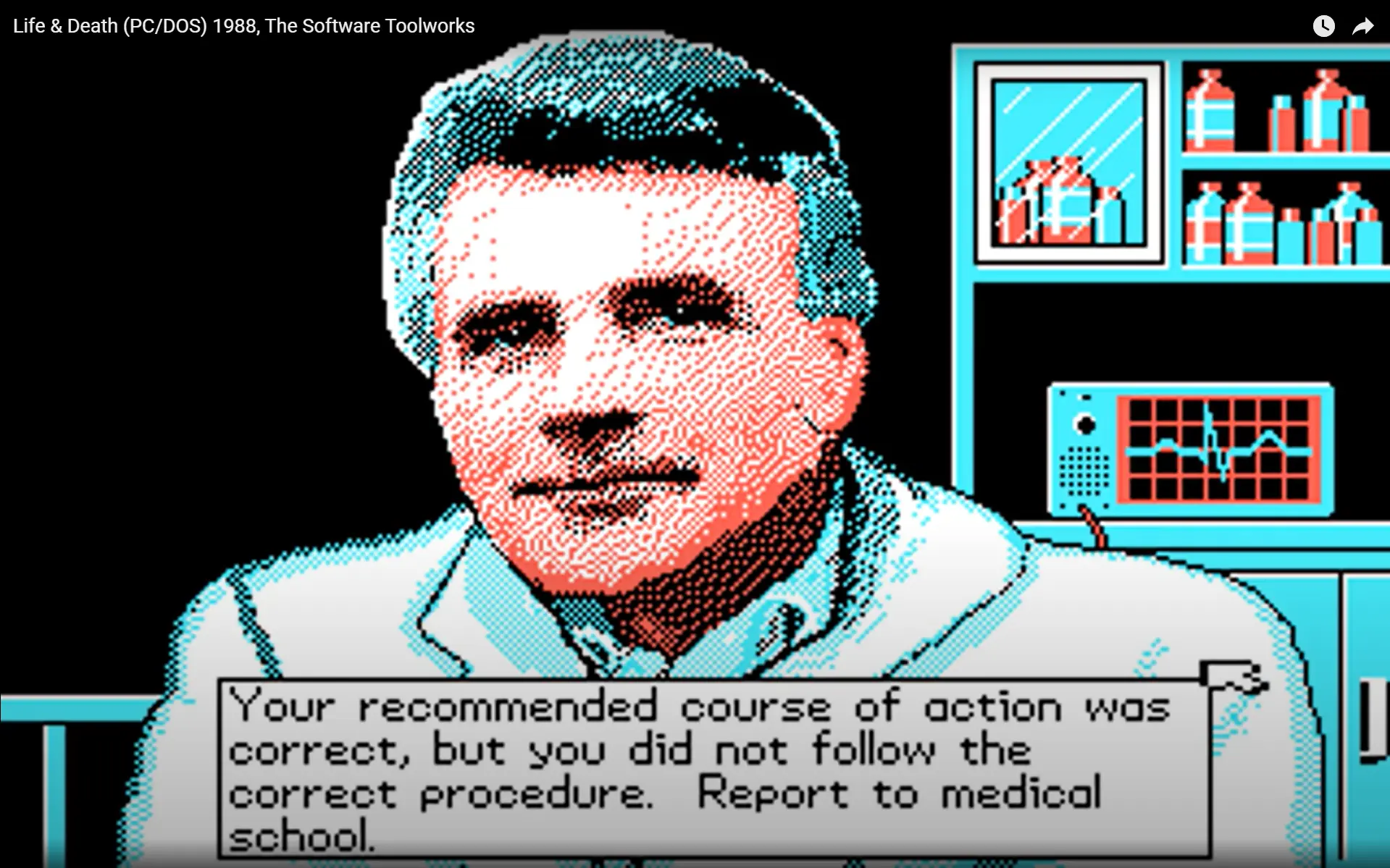
This pioneering surgical simulation puts players in the role of a surgeon diagnosing and performing operations, primarily dealing with abdominal ailments. Realistic for its time, it featured pixel-art patients and tools with emphasis on precision. The game demanded anatomical knowledge and punished mistakes severely. It laid the groundwork for later, more sophisticated surgical sims.
It was one of the first games used in some medical schools for illustrative purposes.
Players respected the game for making them feel the weight of real surgery, even in pixelated form. Some fans recall it as the first game that genuinely made their hands sweat before making an incision. It was educational, unforgiving, and captivating. “It was the first game that made me feel like a real doctor.”
“You nicked an artery. The patient is dead.”
1. Theme Hospital (1997)
Developer: Bullfrog Productions
A humorous and quirky hospital management sim where you build and run your own hospital. Players manage budgets, hire staff, and cure bizarre diseases like “Bloaty Head” and “King Complex.” The game balances comedy with strategy, featuring over-the-top animations and tongue-in-cheek medical references. It’s often praised for its addictiveness and polished British humor.
A spiritual successor, Two Point Hospital, was released in 2018 by original devs.
Fans adore Theme Hospital for its perfect balance of humor and strategy. Many remember it as the game that made management fun and accessible, despite its underlying complexity. Its exaggerated diseases and chaotic staff behavior created endless memorable moments. “It’s still the gold standard for hospital management sims.”